





Round MilDot metric – analogue mil-ranging solver
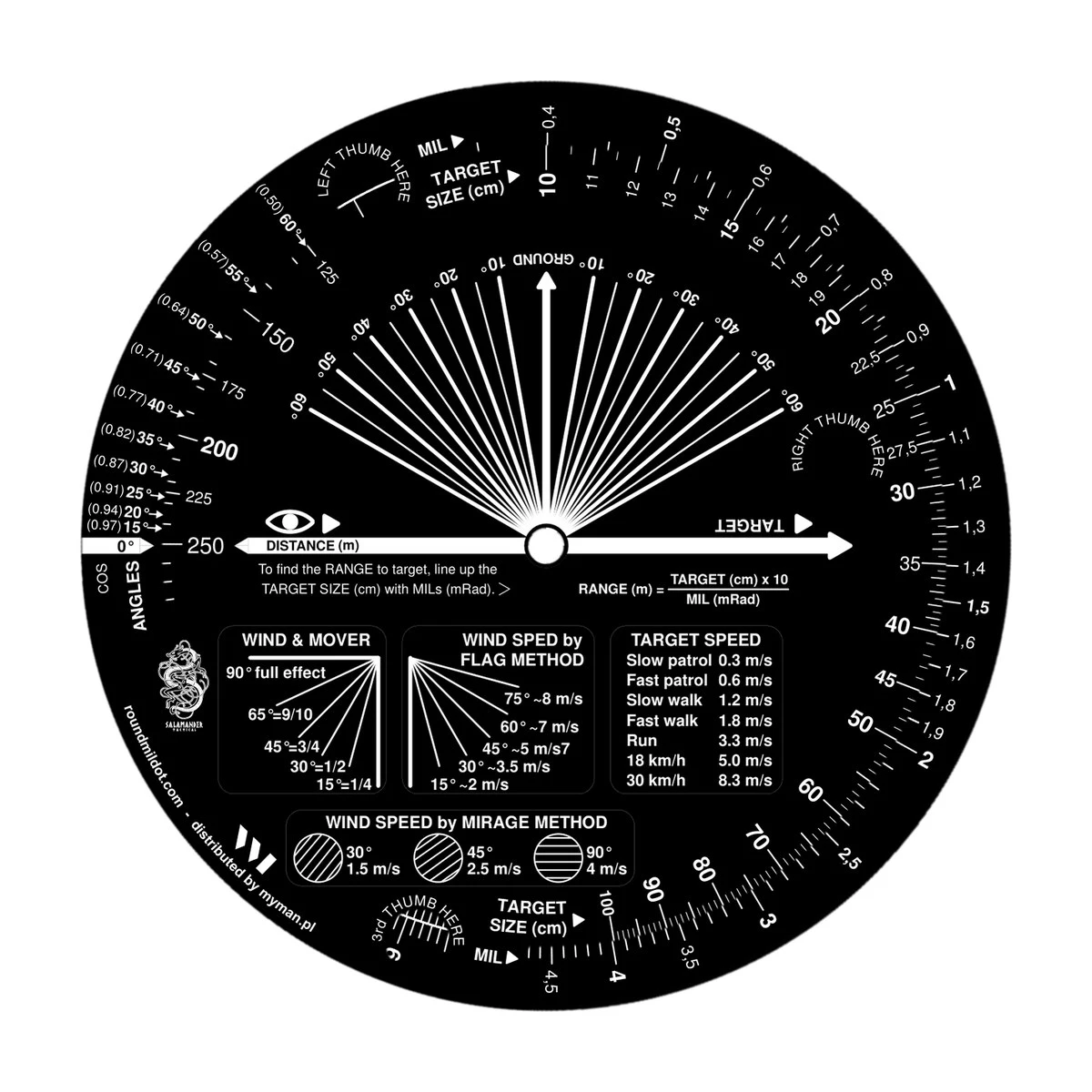
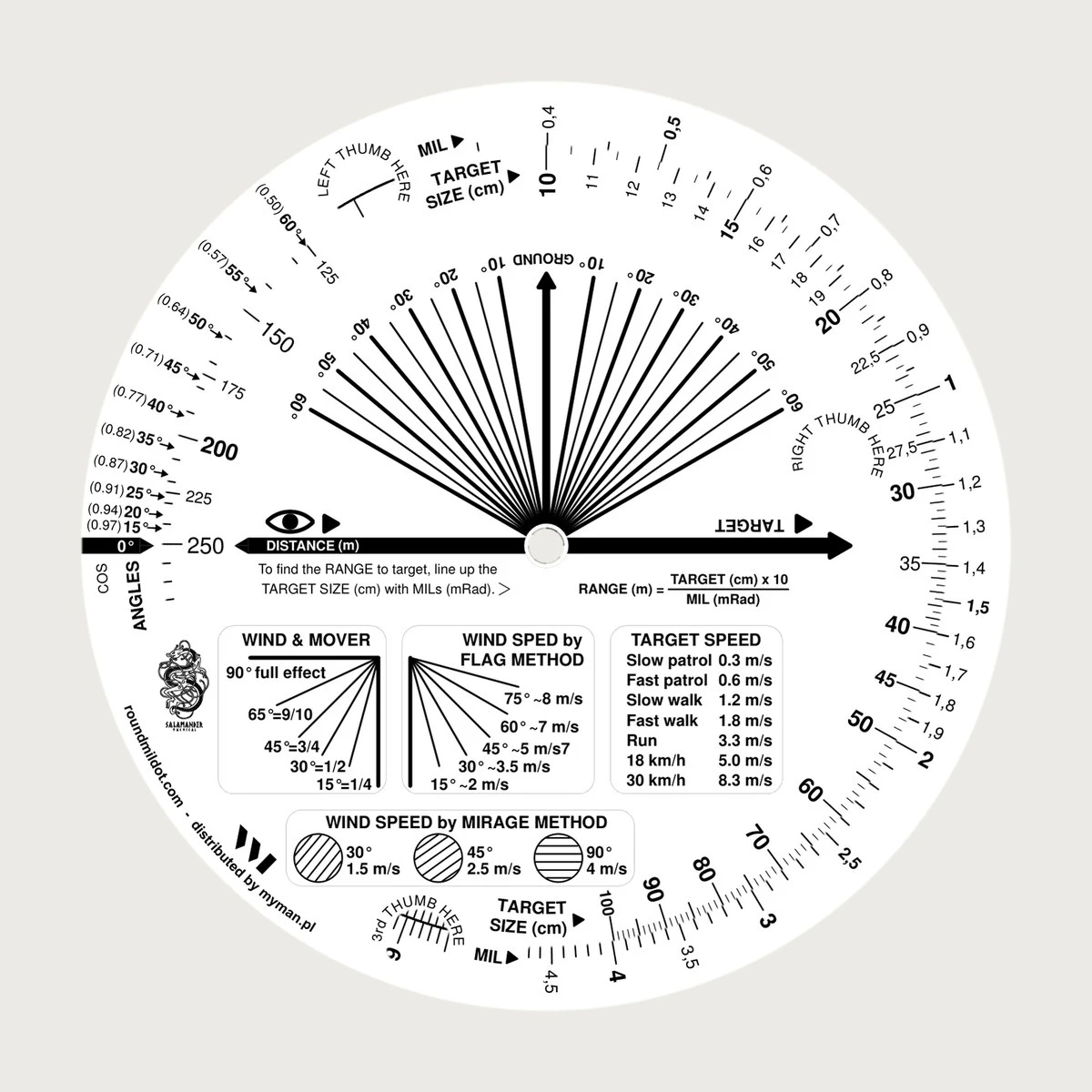
Round MilDot metric: two discs and a rivet. Target size in cm against the reading in mils, range 100–1200 m in the window. Slope arrows with cosine, wind and target-speed tables. No batteries.
Opis
ROUND MILDOT METRIC
Range from the reticle in one turn. No batteries, no emission, no app.
WHO FOR: mid-range shooter, spotter in a pair, hunter — anyone who ranges from the reticle in mils.
Product overview
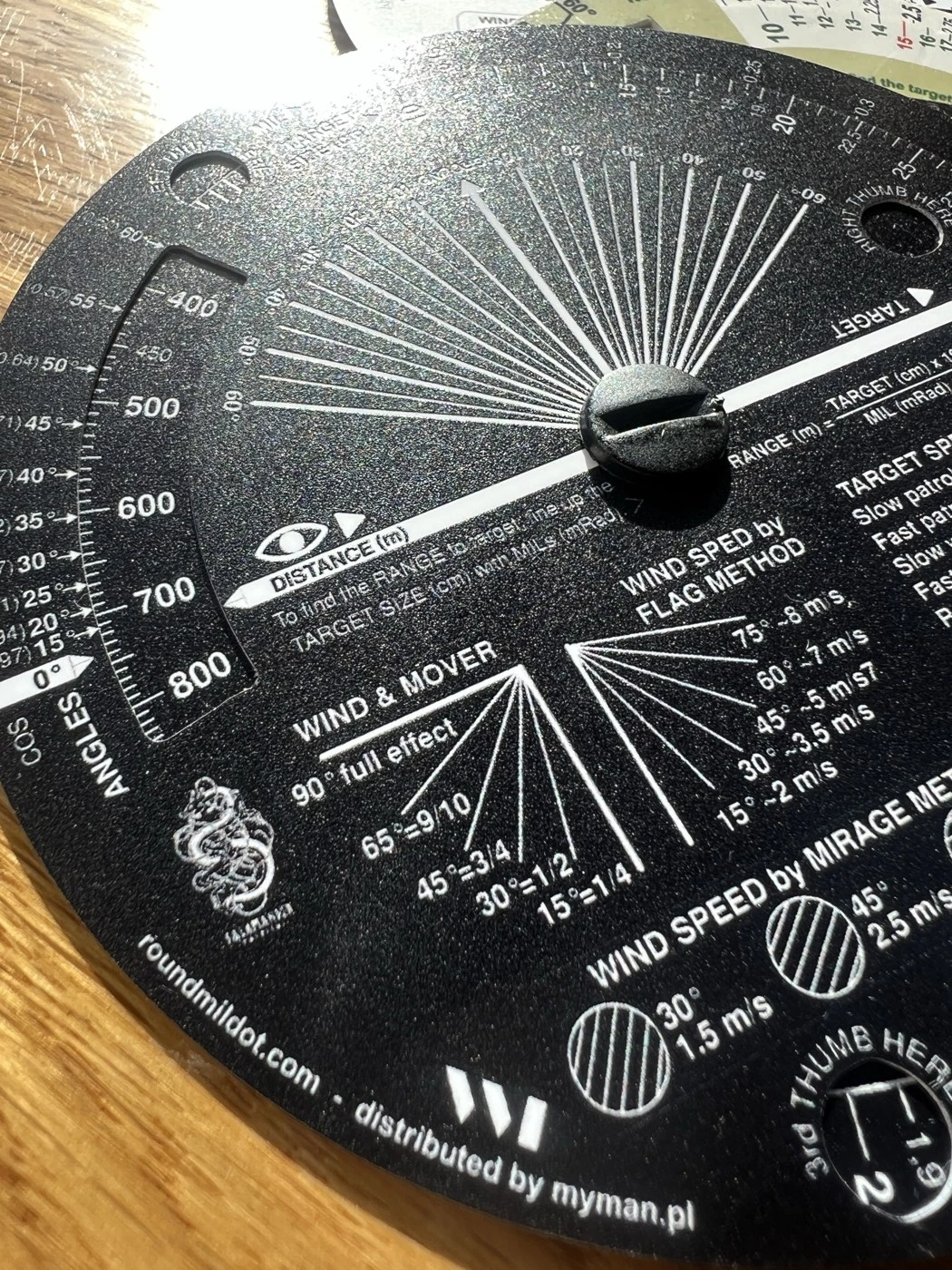
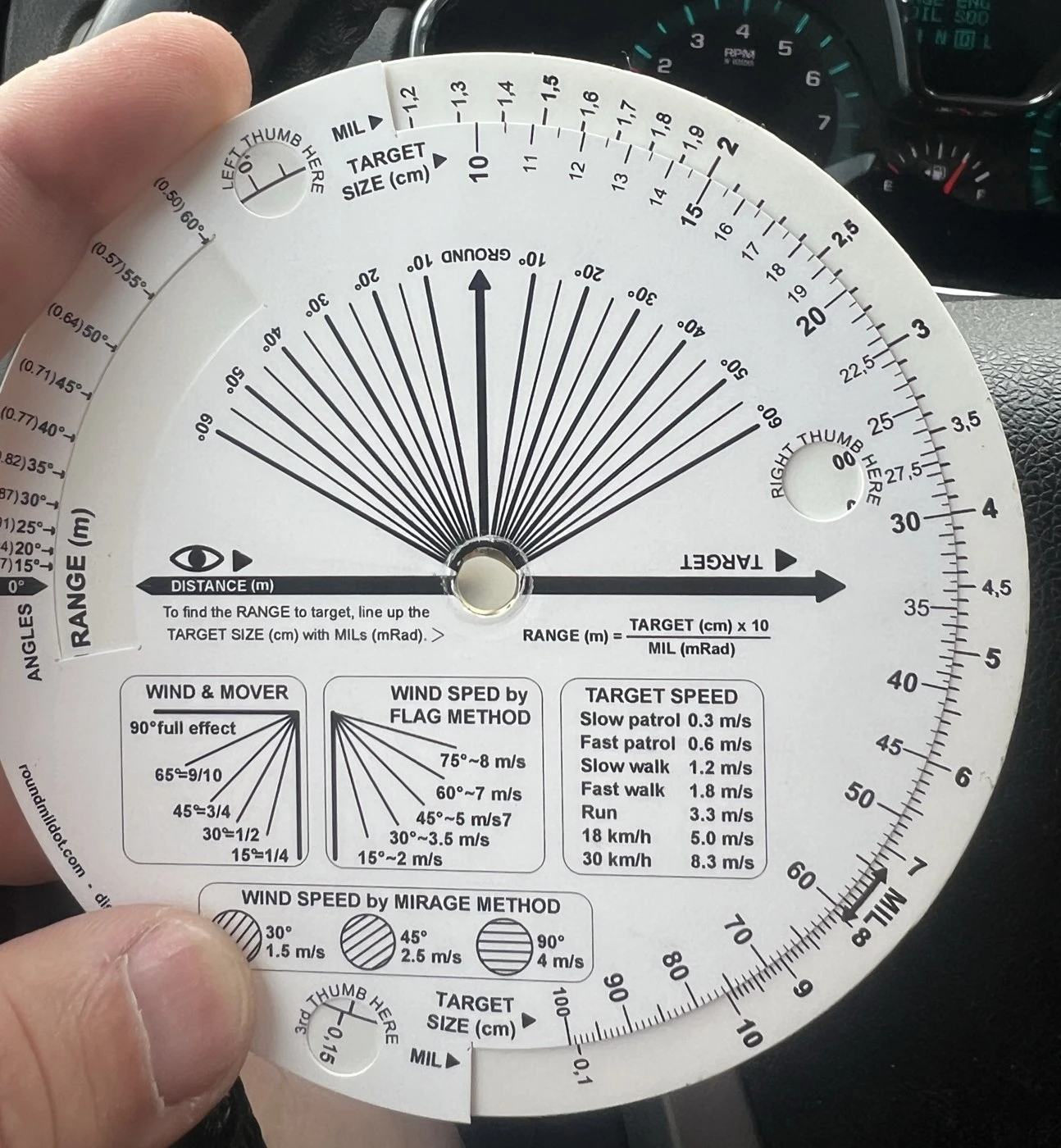
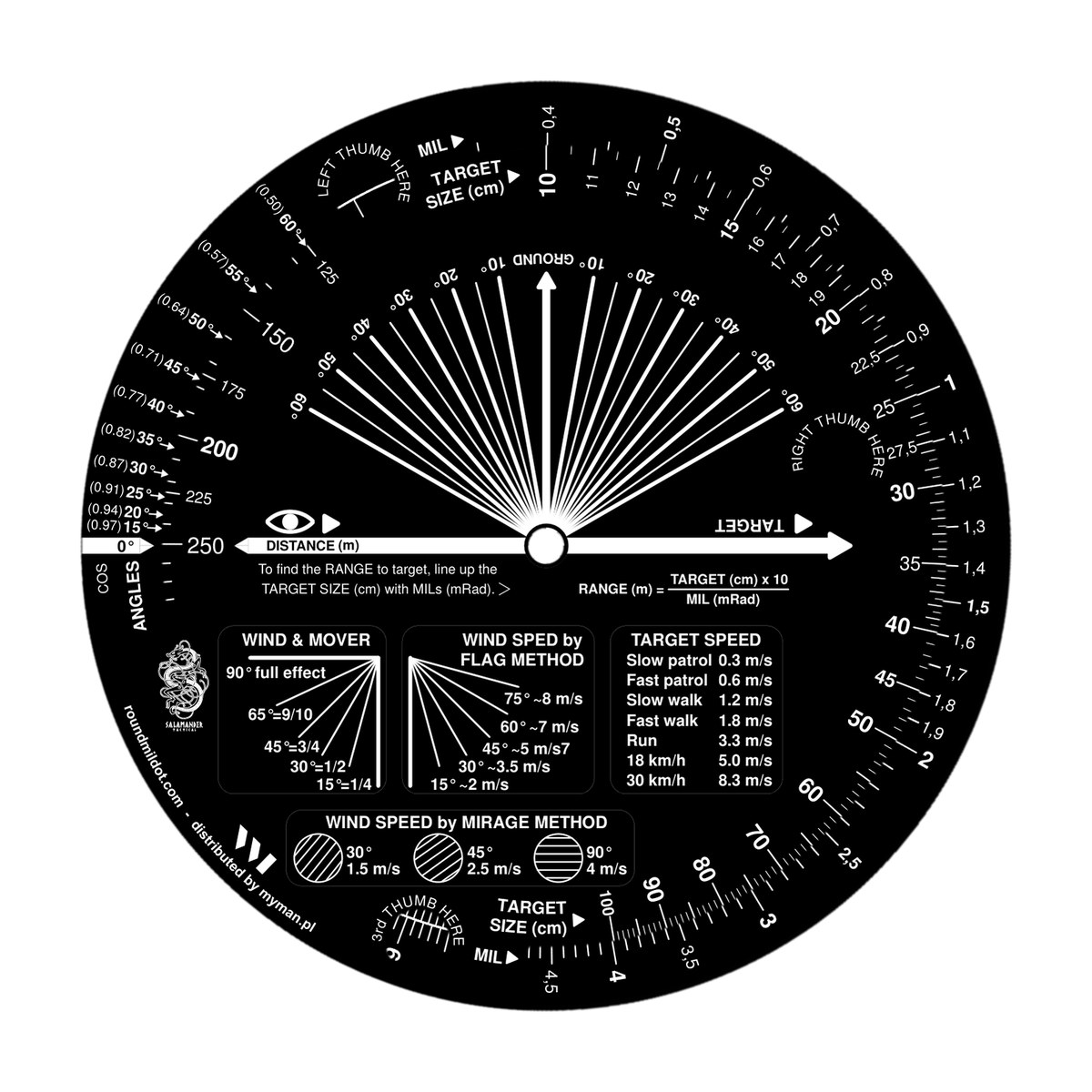
Round MilDot is a logarithmic slide rule bent into a circle: two discs and a rivet. Set the target size in centimetres against your reading in mils and the window shows the range in metres, from 100 to 1200 m.
The formula is printed on the disc — range (m) = target (cm) × 10 ÷ mils — so any result can be checked by hand. What the disc takes away is the division and the decimal point, and behind a rifle, under stress, that is where the mistakes come from.
- Target scale 10–100 cm against the MIL ring 0.1–10
- Range 100–1200 m in the window, logarithmic scale
- Slope arrows 15–60° with cosine: the horizontal range straight away
- Spotter tables: wind from flag and mirage, target speed, angle factor for wind and movers
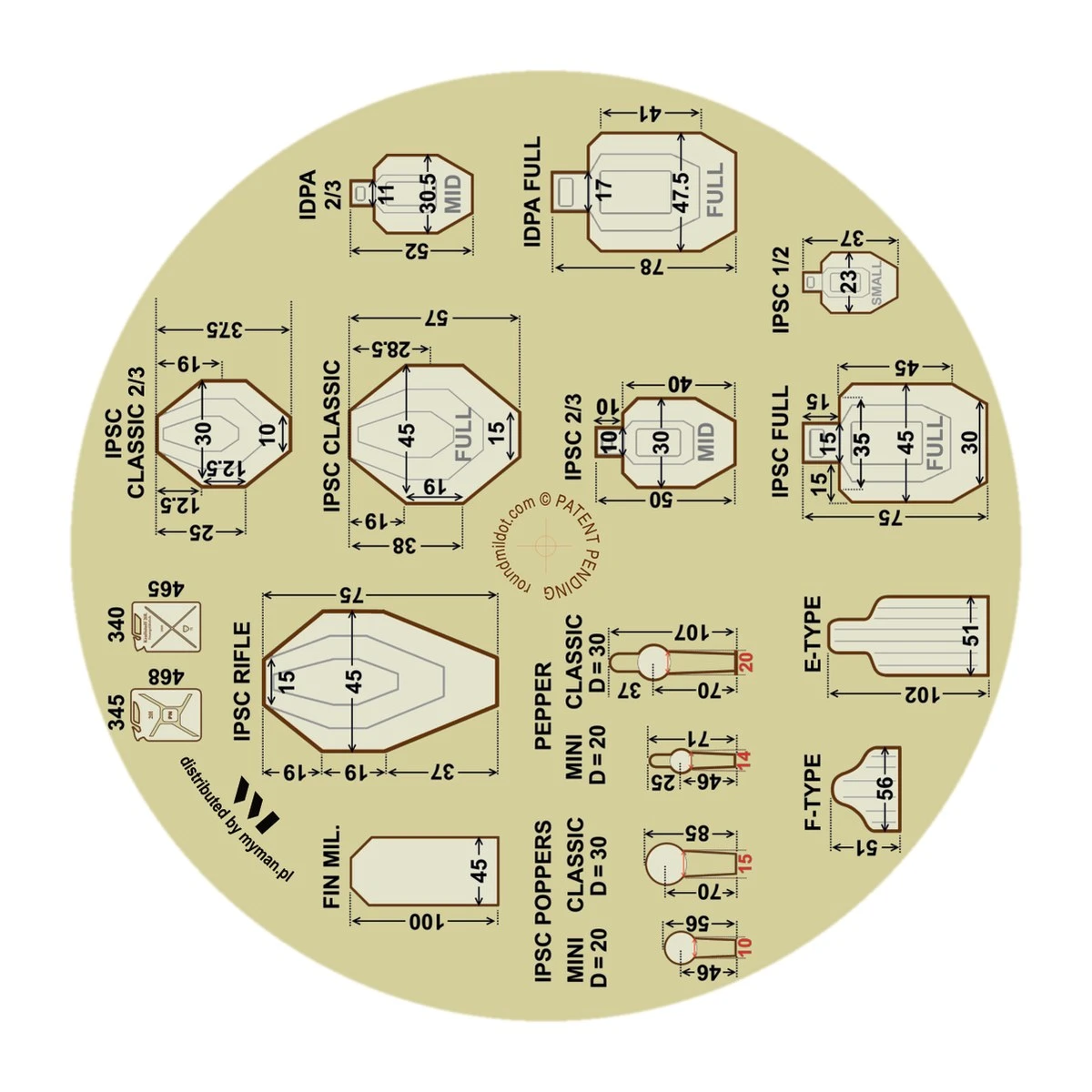
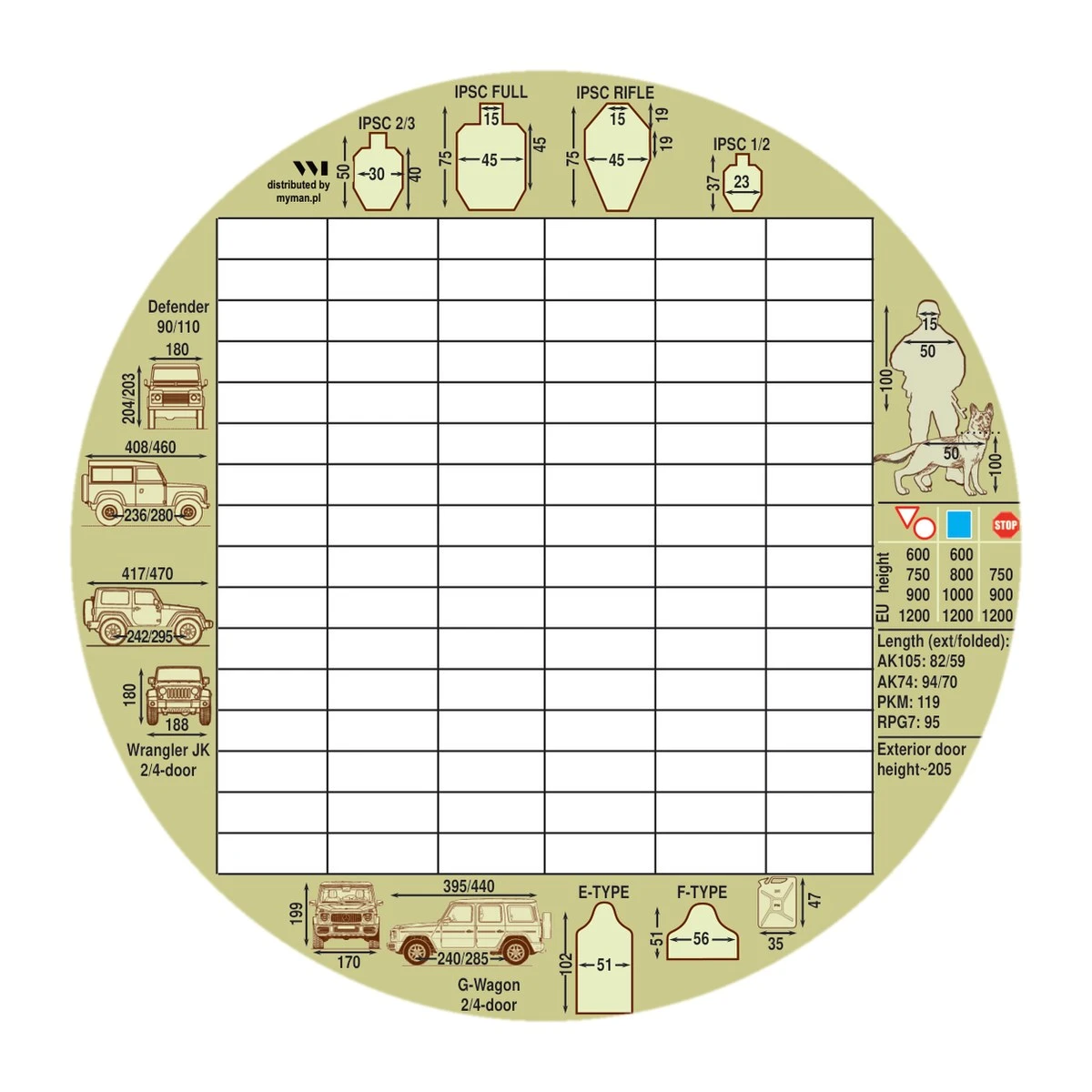
- Dimensions on the back: range targets, or vehicles and road signs — two versions
Expert interpretation
The disc adds no error of its own — your error is the assumed target size and your reading.
Scales accurate to 0.23 %
Measured on the production files: three scales at 170.4° per decade, labels within ±0.15°, reading error across the whole 100–1200 m span at most 0.23 %.
Slope without maths
Read at the arrow for your angle instead of at 0° and you get the horizontal range your DOPE card needs. The arrows sit on the exact cosine.
Targets over 100 cm
Divide size and reading by the same number: a car at 145 cm and 1.45 mils is 72.5 cm at 0.725 mils — 1000 m. The disc works on the ratio.
Error budget
A 10 % error in assumed size is 10 % in range. A 0.1 mil reading error is 20 % at 0.5 mils but only 3 % at 3 mils — range on the largest target you can see.
Who it is for and when
- Mid-range and PRS shooter — range without a laser, on stages that ask for it.
- Spotter in a pair — wind from flag and mirage, target speed and angle factor in one hand.
- Hunter — distance when the laser gets no return from game in grass or fog.
- Training — it teaches the cm × 10 ÷ mils relationship a shooter has to understand anyway.
Who it is NOT for: the disc computes neither elevation nor wind holds in mils — that is your DOPE card or solver. A second focal plane (SFP) reticle reads correctly only at its calibration magnification.
Why analogue
Every electronic device is a battery, an emitter and a single point of failure. A serious ranging plan has layers, and the layers that still work when everything else is off are analogue.
| Layer | Ranging method | Fails when |
|---|---|---|
| First choice | Laser rangefinder | battery, cold, no return from small or wet targets, emission detected |
| Backup | Reticle + Round MilDot | you cannot see the target |
| Fallback | Reticle + printed mil-range table | slower; the table covers fixed sizes only |
| Last resort | Reticle + mental maths: cm × 10 ÷ mils | stress, fatigue, a slipped decimal point |
- Jamming is routine now — Satellite-navigation interference has been reported around the Baltic Sea since 2023. Anything that depends on GNSS or a radio link can be denied. A disc cannot.
- Every emission is a signature — Laser rangefinders and IR illuminators can be picked up by warning receivers and night-vision devices. Looking through a reticle emits nothing.
- Skills decay silently — If the laser does all your ranging, the day it fails you range by guesswork. A few minutes a week with the disc keeps the relationship in your hands.
- Issue one to everyone — No charging, no batteries, no updates. A disc costs a fraction of a rangefinder and can go to every member of a team, a club or a civil-defence unit.
Drills 12″ and 20″ steel plates
Steel plates 12 and 20 inches wide are the standard long-range targets. On the metric disc they are 30.5 and 50.8 cm. Learn the ladder: your partner calls a reading, you set the disc and call the range, then check it against the table.
| 12″ plate · 30.48 cm | Range |
|---|---|
| 1.2 mil | 254 m |
| 1.1 mil | 277 m |
| 1.0 mil | 305 m |
| 0.9 mil | 339 m |
| 0.8 mil | 381 m |
| 0.7 mil | 435 m |
| 0.6 mil | 508 m |
| 0.5 mil | 610 m |
| 0.4 mil | 762 m |
| 0.3 mil | 1016 m |
| 20″ plate · 50.8 cm | Range |
|---|---|
| 1.2 mil | 423 m |
| 1.1 mil | 462 m |
| 1.0 mil | 508 m |
| 0.9 mil | 564 m |
| 0.8 mil | 635 m |
| 0.7 mil | 726 m |
| 0.6 mil | 847 m |
| 0.5 mil | 1016 m |
| 0.4 mil | 1270 m · off scale |
| 0.3 mil | 1693 m · off scale |
Set on the disc: 30.5 cm is half-way between 30 and 31; 50.8 cm just above 50. Values above 1200 m are beyond the disc's range scale: for the 20″ plate at 0.4 and 0.3 mils use the formula.
Verified product data
- ✓ Lower disc: Ø 116 mm — production die
- ✓ Upper disc: Ø 100 mm, window wing to Ø 116 mm — production die
- ✓ Centre hole Ø 4.51 mm, screw rivet — production die, coaxiality < 0.01 µm
- ✓ Scales: target 10–100 cm, MIL 0.1–10, range 100–1200 m — production files
- ✓ Scale reading error ≤ 0.23 % — scale audit on the production files
- ✓ Slope arrows 15–60° — deviation from the cosine at most 0.04°
Technical specification
| Parameter | Value |
|---|---|
| Brand | Round MilDot |
| Model | Round MilDot metric |
| Type | analogue mil-ranging computer |
| Target scale | 10–100 cm |
| MIL scale | 0.1–10 mils |
| Range scale | 100–1200 m, logarithmic |
| Slope correction | arrows 15–60° with cosine |
| Tables | wind (flag, mirage), target speed, angle factor |
| Lower disc | Ø 116 mm |
| Upper disc | Ø 100 mm, window to Ø 116 mm |
| Thumb holes | 3 × Ø 8 mm |
| Fastening | screw rivet, Ø 4.51 mm hole |
| Scale accuracy | labels ±0.15°, reading ≤ 0.23 % |
| Power | none |
| Editions | black, white |
| Back | range version or field version |
How to use it
- 1 · Measure — read how many mils the target covers in the reticle (FFP: any magnification; SFP: the calibration magnification).
- 2 · Set — turn the discs until the target size in cm sits against your reading on the MIL ring.
- 3 · Read — the range in the window at the 0° index, or the horizontal range at the arrow for your slope angle.
Examples: an IPSC target 45 cm at 0.9 mils → 500 m · a torso 50 cm at 2 mils → 250 m · a 240 l wheelie bin (110 cm, half of it 55 cm) at 1.1 mils → 500 m.
Editions and disc back
- Black — white print on black matte polymer.
- White — black print on white.
- Range back — IPSC and IDPA targets, poppers, E and F type silhouettes, in cm.
- Field back — vehicles, a crouching figure with a dog, weapon lengths, road sign dimensions and a grid for notes.
Frequently asked questions
01I have an MOA reticle. Will it work?
The scales are in milliradians. Divide an MOA reading by 3.438 to get mils. It is still better to range in the same system as your reticle.
02At which magnification do I measure?
FFP reticles: any magnification. SFP reticles: only at the magnification the reticle is calibrated for, usually the highest. Otherwise the mil reading is wrong and the disc computes the wrong range precisely.
03The target is bigger than 100 cm.
Range a part of it, or divide size and reading by the same number: 175 cm at 3.5 mils equals 87.5 cm at 1.75 mils — 500 m.
04Does the disc compute elevation?
No. Elevation depends on your cartridge, barrel and atmosphere. Take the range from the disc to your own DOPE card or ballistic solver.
05Slant or horizontal range?
The 0° index gives the slant range. Read at the arrow for your slope angle and you get the horizontal range your ballistic table needs. Above about 30° and 600 m use the angle in your solver.
06Will it survive rain and cold?
There are no electronics. Clean it, dry it, use it.
07Is there a version in yards?
Yes — a US edition in inches and yards exists. Write to us and we will tell you what is available.
08Clubs, schools, units?
Yes — write to us for bulk and training-set pricing.
Safety and manufacturer
Questions about the edition, or a bulk order?
Write to us — we will help you choose the back version and prepare a quote for a club or a unit.


